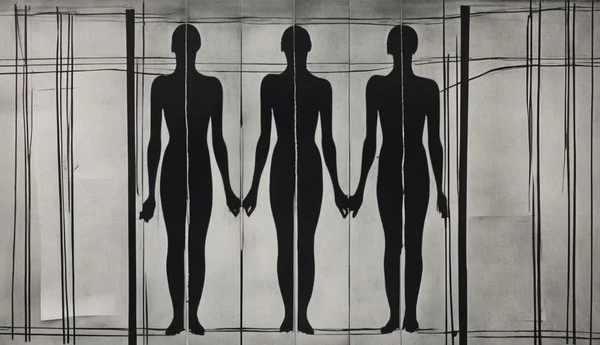
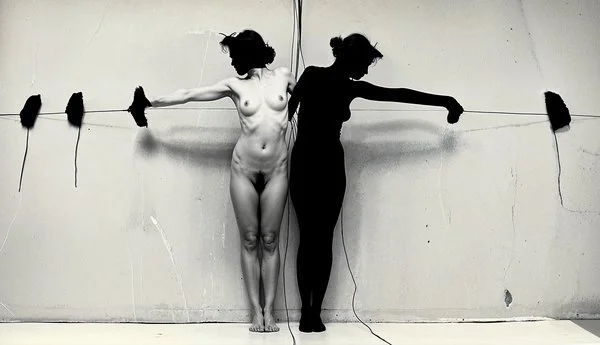
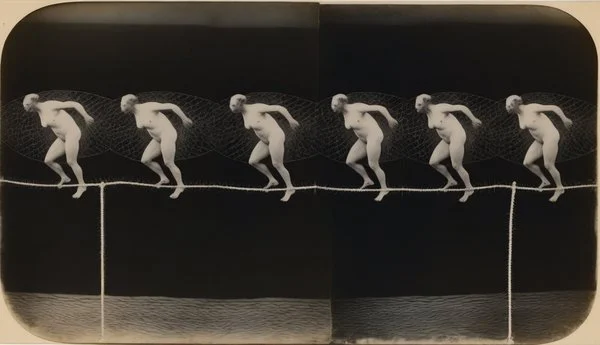
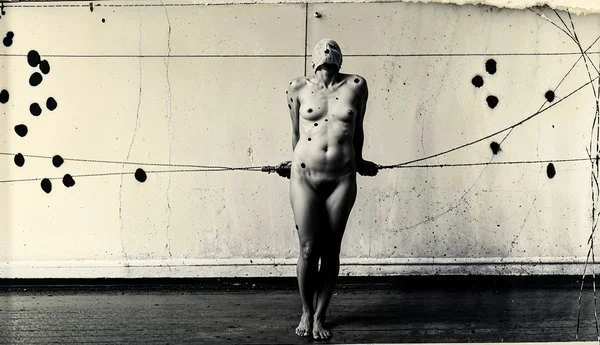
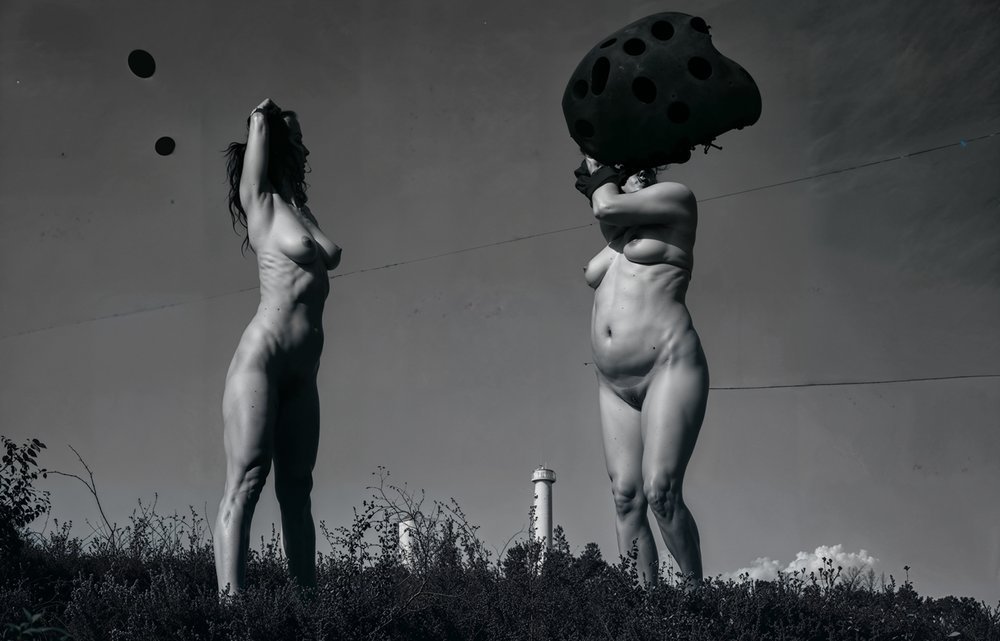
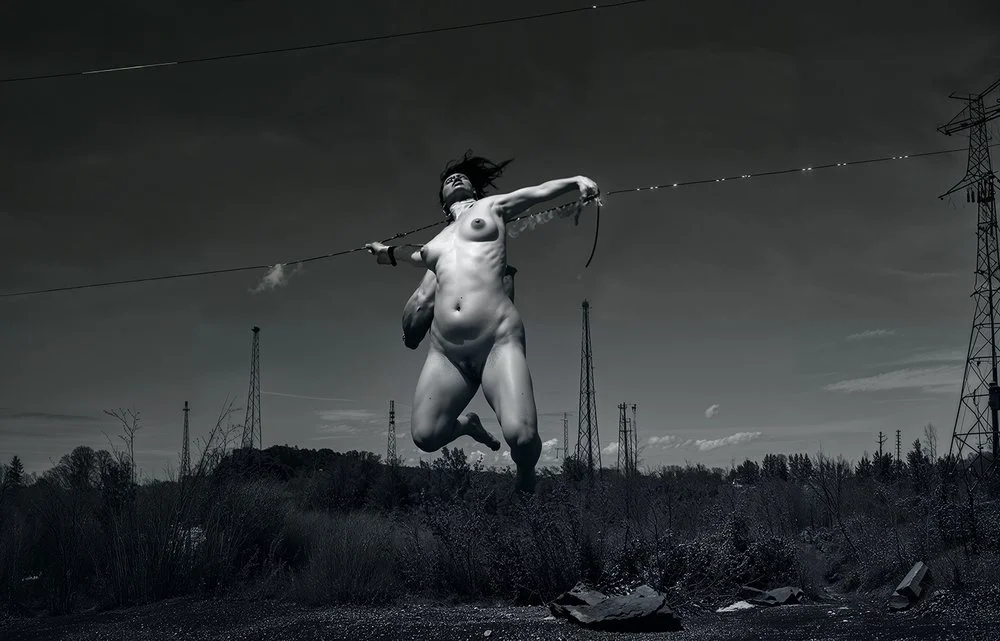
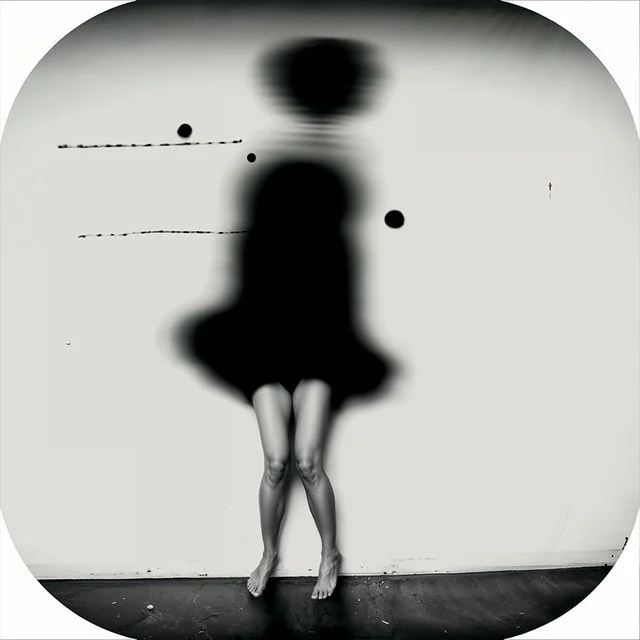
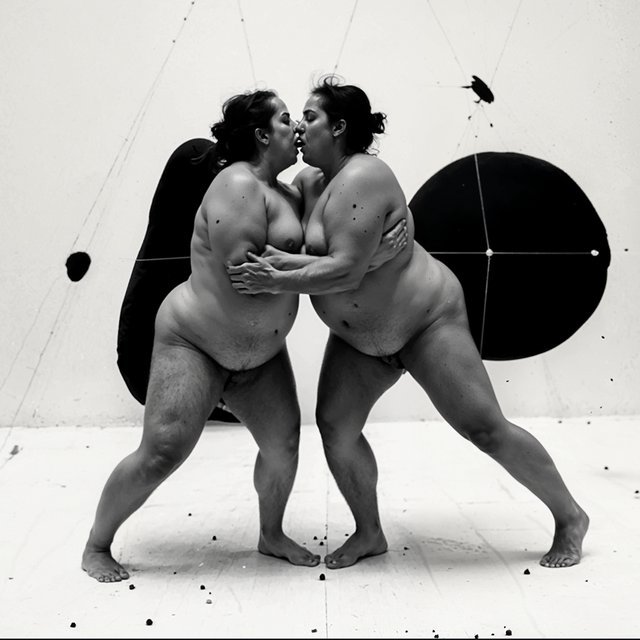
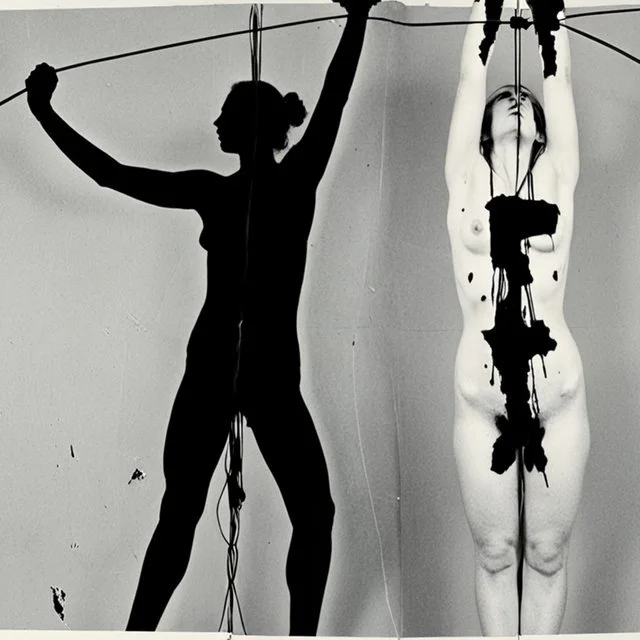
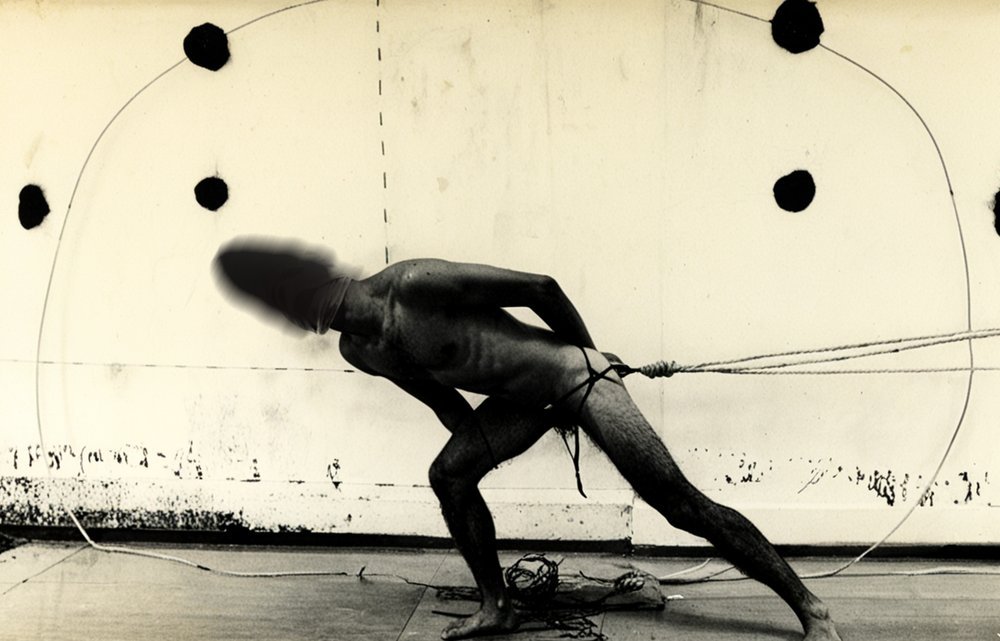
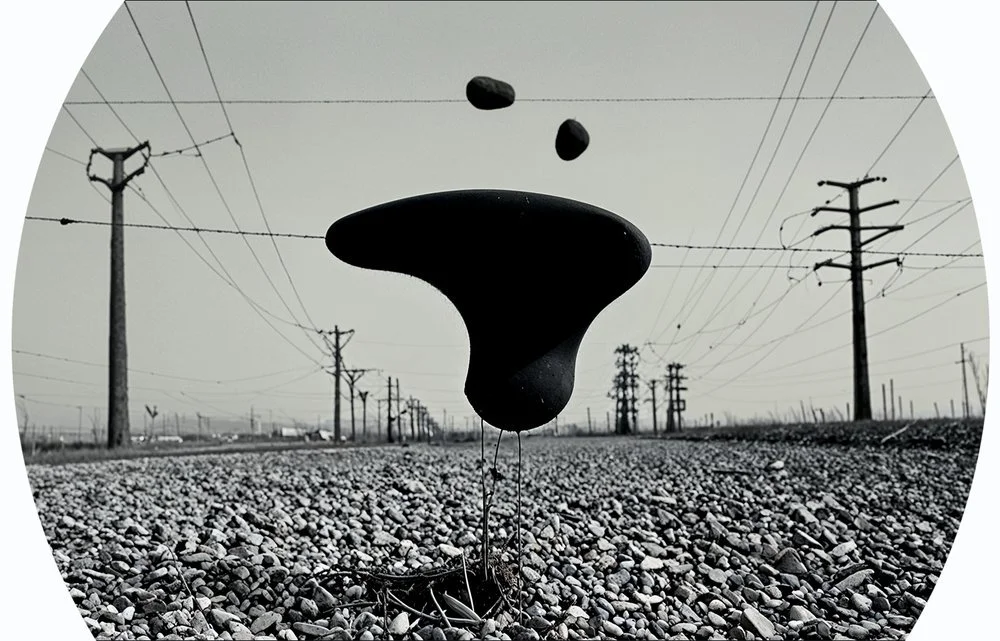
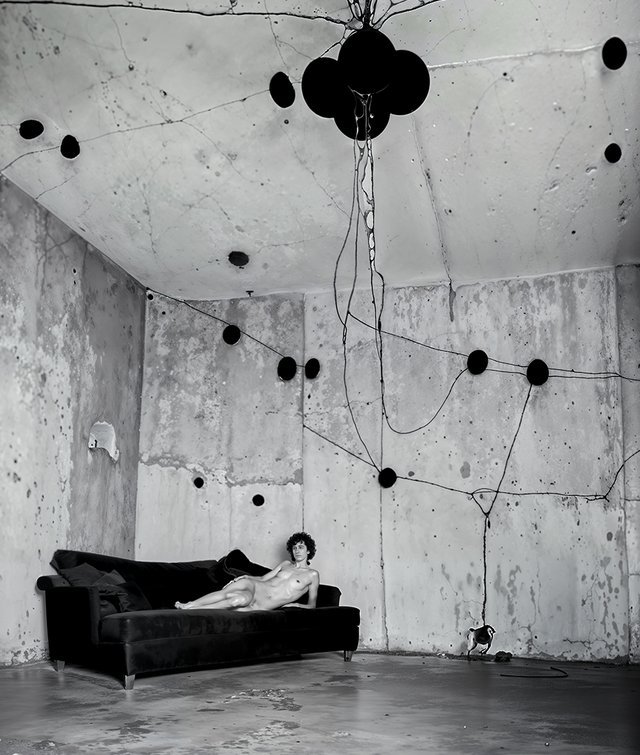
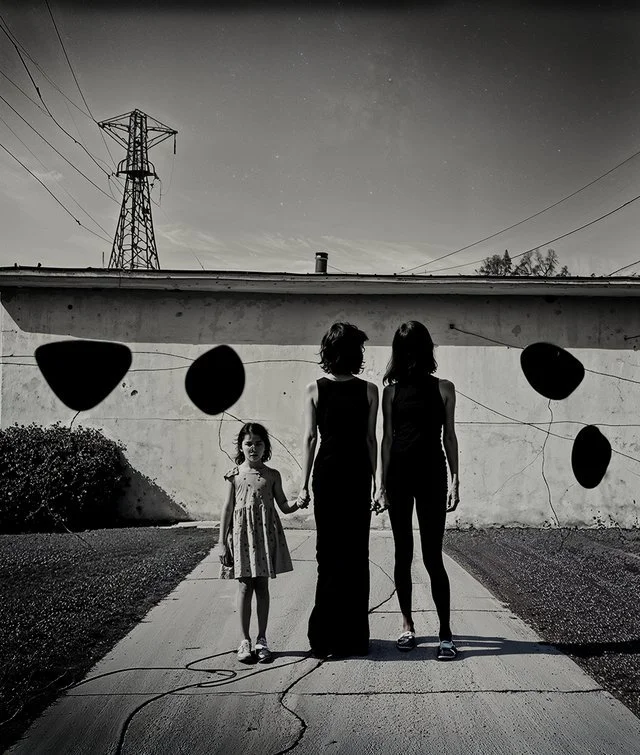
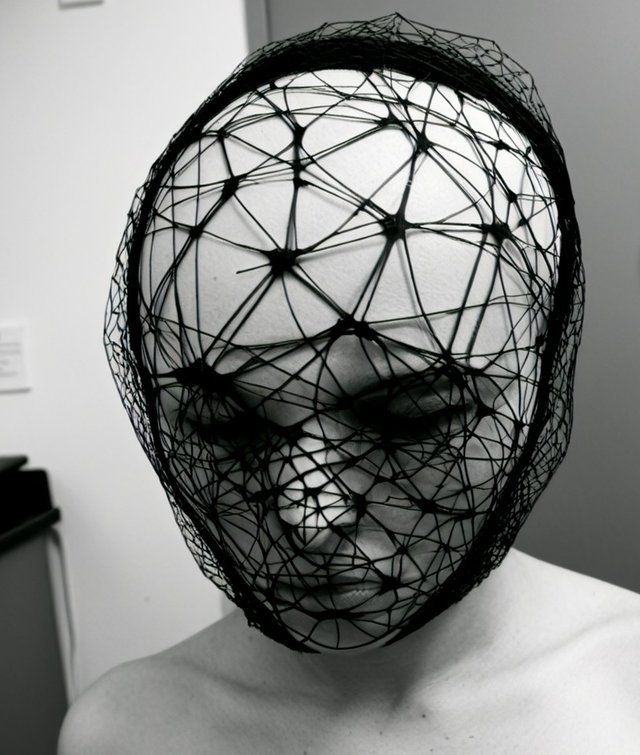
IndSurrealStyle started in the darkroom: composite prints of blindfolded figures, black ovals on taut wire, and power lines running through industrial ground. I wanted to know whether a model could learn that visual language without flattening it. I curated the dataset, wrote and restructured the captions, and ran the training on Civitai, testing base models until the outputs started to feel like mine. This page documents the pipeline, including the parts that failed.
Legend
socket — an element entering or leaving
wire — what carries forward
broken connection — dropped
node — one step of the pipeline
01source
02dataset
03captions
04training
05output
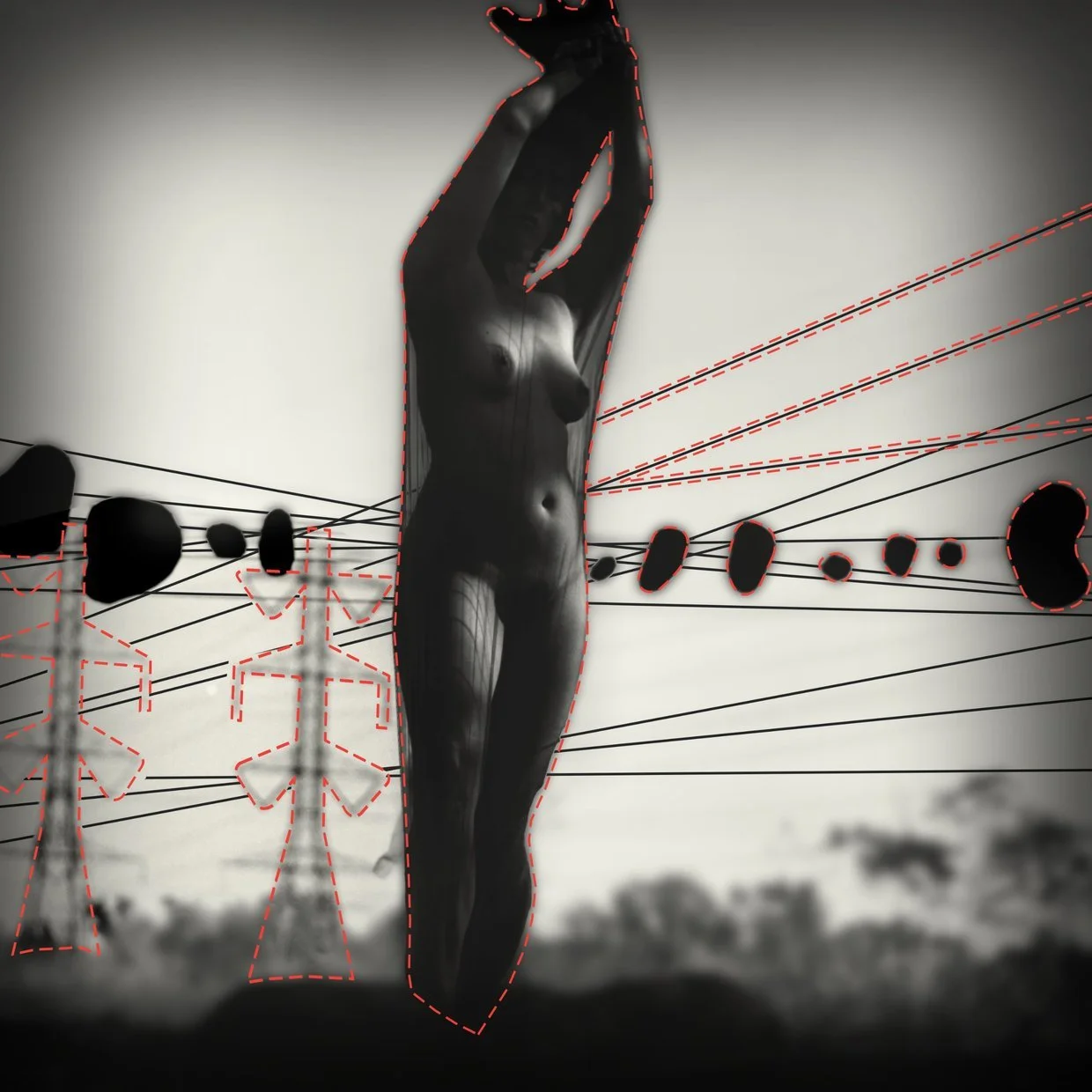
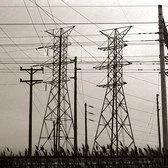
fig. 01 — one print, broken into the four elements that recur across the whole body of work.
component · 01
dots & spots
black ovals strung on taut wire
component · 02
lines
power lines, wire, tension across the frame
component · 03
distorted figure
veiled, blindfolded — body as conduit
component · 04
industrial background
pylons, fields, infrastructure
the dataset
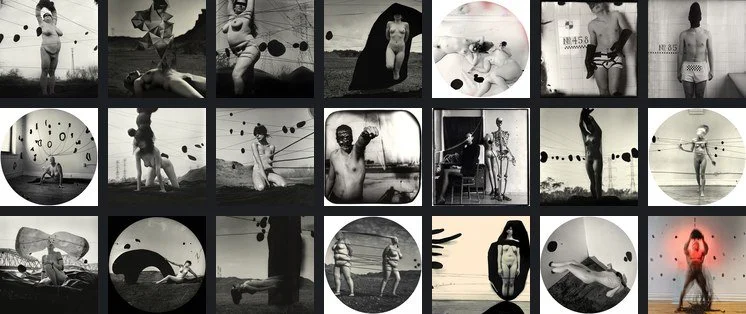
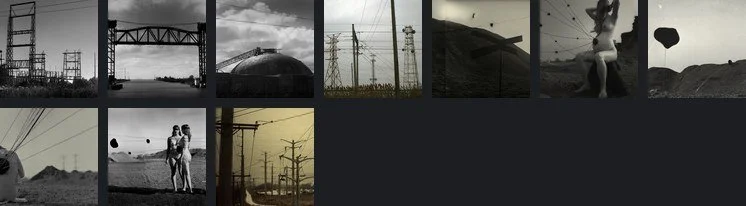
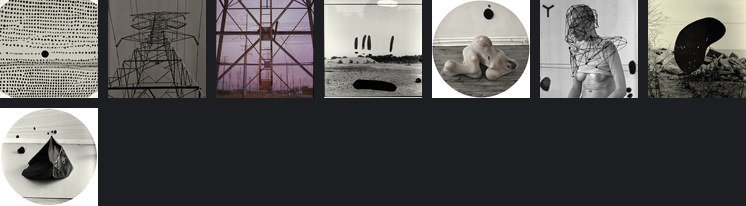
My first dataset was what I thought was a random collection of my most representative images, and the results were unsatisfactory. For the final run I sorted forty-five images into four categories, so each element of the work was represented on purpose instead of by chance.
45images 4 categories
category · a21 imgs
models / figures
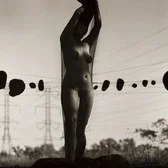
← figure
category · b10 imgs
industrial landscape
← industrial · lines
category · c8 imgs
macro / details
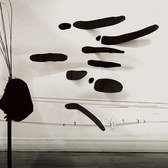
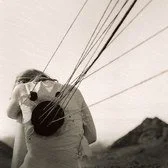
← dots · lines
category · d6 imgs
interior / studio
← figure · dots
captions as vocabulary
Each image was captioned and then reduced to keyword tag strings anchored by a single trigger token. This is where I described my own work to a machine, one tag at a time.
caption encoder45 → tag strings
trigger tokenIndSurrealStyle
tags
darkroom compositefloating black ovalsthin stringsface obscuredemulsion damageindustrial hillsheavy grain
IndSurrealStyle, surrealist photography, darkroom composite, monochrome, wide format, nude figure, female, frontal, face obscured, dark horizontal bar, floating black ovals, suspended shapes, thin strings, film scratches, emulsion damage, industrial hills, heavy grain
what broke
The first LoRA run on base SDXL captured the surreal-industrial mood, but everything came out too melty: the figure and the background lost their structure (loss of structural coherence).
changing the base
After experimenting with different models, CyberRealisticXL and Jib Mix Realistic XL matched the results I wanted. Both work in unison with my LoRA, producing images that are a seamless blend of surrealism and reality.
the final polish
CyberRealisticXL and Jib Mix improved the images a lot, but the final output needed a higher resolution. Magnific's creative upscaler hit the spot: it took the images up to 8K and added a final layer of polish.
base model✕ dropped
SDXL base
mood ✓ · structure ✗ — too melty
base modelkept
CyberRealisticXL / Jib Mix Realistic XL
great rendition, not enough resolution
AI enhancerfinal step
Magnific Creative
upscaled to 8K · final polish
outputs
Without my LoRA, the same prompts produce images that are just strange and unformed. With it, the model captured my visual style almost perfectly, along with something I was aiming for: an unsettling feeling. Some of the images even unsettle me.
The keywords map onto my world. “Outdoor” or “industrial landscape” produced exactly the kind of places I photograph in. “Bright studio” and “dark studio” nearly replicated the studio where I shoot my indoor work. And my signature black spots and dots appear throughout, fully integrated rather than pasted on.
What interests me most is how it transforms ordinary prompts. Ask for an “interior” or a “family photo” and something weird comes back.
no token+ IndSurrealStyle
same prompt, left to right: base model vs. my LoRA
The experiment exceeded my expectations. I never imagined the generated images would come this close to my own, matching both the quality and the mood of my industrial landscapes and my studio work.
I nerd out over the details: the no man's land weeds, the rendering of flesh, muscle and skin, the occasional dead-pixel artifact. Above all, I love the random distortions, which make some of the images genuinely unsettling.
Some people say AI will destroy creativity. I see it as another tool, albeit a very powerful one, in the hands of creative people. Working on this project, it felt like even more than that: a collaboration. I gave the machine my visual language, and it gave back things I would never have made on my own, a true fusion of man and machine. It also made me question my own art. When a model can make images that feel 95% like mine, hundreds of them in minutes, I have to ask what the remaining 5% is, and that question is pushing me to evolve my work rather than abandon it. It won't replace my medium format film camera, but it has already opened up new artistic ideas for me.
sebastianrut.com / labIndSurrealStyle LoRA
Lab / [03] — IndSurrealStyle LoRA[2026]
teaching a machine my darkroom
IndSurrealStyle started in the darkroom: composite prints of blindfolded figures, black ovals on taut wire, and power lines running through industrial ground. I wanted to know whether a model could learn that visual language without flattening it. I curated the dataset, wrote and restructured the captions, and ran the training on Civitai, testing base models until the outputs started to feel like mine. This page documents the pipeline, including the parts that failed.
01source
fig. 01 — one print, broken into the four elements that recur across the whole body of work.
component · 01
dots & spots
black ovals strung on taut wire
component · 02
lines
power lines, wire, tension across the frame
component · 03
distorted figure
veiled, blindfolded — body as conduit
component · 04
industrial background
pylons, fields, infrastructure
02dataset
the dataset
My first dataset was what I thought was a random collection of my most representative images, and the results were unsatisfactory. For the final run I sorted forty-five images into four categories, so each element of the work was represented on purpose instead of by chance.
45images · 4 categories
category · a21 imgs
models / figures
← figure
category · b10 imgs
industrial landscape
← industrial · lines
category · c8 imgs
macro / details
← dots · lines
category · d6 imgs
interior / studio
← figure · dots
03captions
captions as vocabulary
Each image was captioned and then reduced to keyword tag strings anchored by a single trigger token. This is where I described my own work to a machine, one tag at a time.
caption encoder45 → tag strings
trigger token
IndSurrealStyle
tags
darkroom compositefloating black ovalsthin stringsface obscuredemulsion damageindustrial hillsheavy grain
IndSurrealStyle, surrealist photography, darkroom composite, monochrome, wide format, nude figure, female, frontal, face obscured, dark horizontal bar, floating black ovals, suspended shapes, thin strings, film scratches, emulsion damage, industrial hills, heavy grain
04training
what broke
The first LoRA run on base SDXL captured the surreal-industrial mood, but everything came out too melty: the figure and the background lost their structure (loss of structural coherence).
base model✕ dropped
SDXL base
mood ✓ · structure ✗ — too melty
changing the base
After experimenting with different models, CyberRealisticXL and Jib Mix Realistic XL matched the results I wanted. Both work in unison with my LoRA, producing images that are a seamless blend of surrealism and reality.
base modelkept
CyberRealisticXL / Jib Mix Realistic XL
great rendition, not enough resolution
the final polish
CyberRealisticXL and Jib Mix improved the images a lot, but the final output needed a higher resolution. Magnific's creative upscaler hit the spot: it took the images up to 8K and added a final layer of polish.
AI enhancerfinal step
Magnific Creative
upscaled to 8K · final polish
05output
outputs
Without my LoRA, the same prompts produce images that are just strange and unformed. With it, the model captured my visual style almost perfectly, along with something I was aiming for: an unsettling feeling. Some of the images even unsettle me.
The keywords map onto my world. “Outdoor” or “industrial landscape” produced exactly the kind of places I photograph in. “Bright studio” and “dark studio” nearly replicated the studio where I shoot my indoor work. And my signature black spots and dots appear throughout, fully integrated rather than pasted on.
What interests me most is how it transforms ordinary prompts. Ask for an “interior” or a “family photo” and something weird comes back.
no token+ IndSurrealStyle
same prompt, left to right: base model vs. my LoRA
selected outputs
what it taught me
The experiment exceeded my expectations. I never imagined the generated images would come this close to my own, matching both the quality and the mood of my industrial landscapes and my studio work.
I nerd out over the details: the no man's land weeds, the rendering of flesh, muscle and skin, the occasional dead-pixel artifact. Above all, I love the random distortions, which make some of the images genuinely unsettling.
Some people say AI will destroy creativity. I see it as another tool, albeit a very powerful one, in the hands of creative people. Working on this project, it felt like even more than that: a collaboration. I gave the machine my visual language, and it gave back things I would never have made on my own, a true fusion of man and machine. It also made me question my own art. When a model can make images that feel 95% like mine, hundreds of them in minutes, I have to ask what the remaining 5% is, and that question is pushing me to evolve my work rather than abandon it. It won't replace my medium format film camera, but it has already opened up new artistic ideas for me.